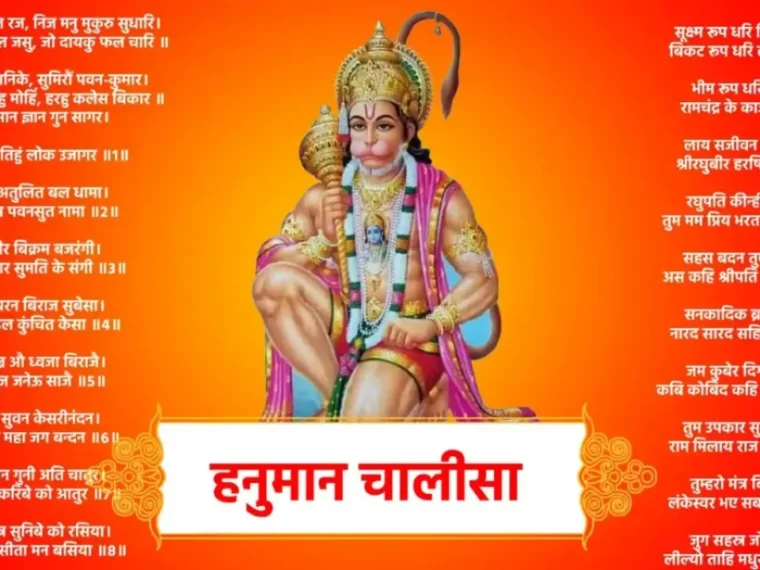
Hanuman Chalisa lyrics in Hindi: The Shri Hanuman Chalisa is more than just a prayer; it is a spiritual anchor for millions of people worldwide. Composed by the 16th-century poet-saint Goswami Tulsidas, these forty verses (Chaupais) are dedicated to Lord Hanuman, the epitome of devotion, strength, and humility. While written in Awadhi, a dialect of Hindi, its resonance transcends linguistic barriers, providing a roadmap for spiritual resilience and mental clarity.
In this comprehensive guide, we explore the deep significance of the lyrics, the historical context of its creation, and why it remains a cornerstone of Hindu devotion in the modern age.
The Origin: A Prison Cell Miracle
The legend behind the composition of the Hanuman Chalisa is as inspiring as the lyrics themselves. It is said that the Mughal Emperor Akbar imprisoned Tulsidas after the poet refused to perform a miracle in the royal court. While in his cell, Tulsidas composed these forty verses in praise of Hanuman.
Tradition holds that as he completed the final verse, an army of monkeys descended upon the city, creating such chaos that the Emperor was forced to release the saint. This origin story highlights the core theme of the prayer: liberation from bondage—be it physical, mental, or spiritual.
Structural Breakdown of the Lyrics
The word “Chalisa” is derived from the Hindi word chalis, meaning forty. This refers to the forty chaupais (four-lined verses) that make up the main body of the hymn. The structure follows a precise spiritual progression:
1. The Invocation (The Opening Dohas)
The prayer begins with two couplets known as Dohas.
Shri Guru Charan Saroj Raj, Nij Manu Mukuru Sudhari Barnau Raghuvar Bimal Jasu, Jo Dayaku Phala Chari
In these lines, the devotee uses the “dust of the Guru’s lotus feet” to clean the “mirror of the mind.” This is a crucial psychological step: one cannot receive divine wisdom if the mind is clouded by ego or distraction. The devotee then admits their lack of intelligence (Buddhiheen Tanu Janike) and asks Hanuman for strength, wisdom, and knowledge.
2. The Celebration of Form (Verses 1–10)
The initial chaupais describe Hanuman’s physical and divine attributes. The lyrics paint a vivid picture: his golden complexion, his lightning-bolt strength (Bajrangi), and his adornments like the sacred thread and ear ornaments. These verses serve as a form of “Dhyana” or meditation, helping the practitioner visualize the deity.
3. The Heroic Saga (Verses 11–20)
This section chronicles Hanuman’s role in the Ramayana. The lyrics celebrate his wisdom (Vidyavan Guni Ati Chatur), his eagerness to serve Rama, and his miraculous feats—such as burning Lanka, bringing the Sanjivani herb to save Lakshmana, and ending the grief of Mother Sita. These lines remind the devotee that no task is impossible for those who possess unwavering faith.
4. The Spiritual Grant (Verses 21–38)
The latter half of the Chalisa focuses on the benefits of chanting. It identifies Hanuman as the protector (Rakhware) whom no one can challenge. The lyrics famously state:
“Sankat te Hanuman chhudave, Man Kram Bachan dhyan jo lave”
This promises that anyone who remembers Hanuman through thought, deed, and word will be delivered from distress. It also mentions the “Eight Siddhis” (supernatural powers) and “Nine Nidhis” (treasures) that Hanuman can grant to his devotees.
5. The Final Plea (Verses 39–40 and Closing Doha)
The prayer concludes by affirming that whoever recites this a hundred times will be freed from the cycles of rebirth and attain supreme bliss. The final Doha asks Hanuman to reside forever in the devotee’s heart along with Lord Rama, Sita, and Lakshmana.
Scientific and Mathematical Wonders in the Lyrics
One of the most fascinating aspects of the Hanuman Chalisa is the hidden scientific insight found in verse 18:
“Yug Sahastra Yojan Par Bhanu, Leelyo Tahi Madhur Phal Janu”
Centuries before modern telescopes, Tulsidas described the distance to the Sun (Bhanu). If we look at ancient Vedic measurements:
-
1 Yug = 12,000 years
-
1 Sahastra = 1,000
-
1 Yojan = 8 miles
Multiplying , we get 96,000,000 miles. This is remarkably close to the average distance between the Earth and the Sun ( million miles), showcasing the profound cosmic awareness embedded in these Hindi lyrics.
Why Recite the Hanuman Chalisa?
The lyrics are not just words; they are “Mantras” that create a specific vibration.
-
Overcoming Fear: The verse “Bhoot Pisach Nikat Nahi Ave” is often chanted to ward off negative energy and phobias. It instills a sense of divine protection.
-
Mental Clarity: In a world of “Information Overload,” the rhythmic repetition of the Chalisa acts as a grounding mechanism, reducing cortisol levels and increasing focus.
-
Cultivating Humility: Despite having the power to swallow the sun, Hanuman is the ultimate servant. The lyrics teach us that true power is found in service and ego-dissolution.
How to Read and Practice
To fully experience the power of the Hanuman Chalisa, practitioners often follow these traditional guidelines:
-
Cleanliness: Taking a bath before recitation is standard to prepare the body for high-vibrational energy.
-
Timing: While it can be read anytime, Tuesday and Saturday are considered particularly auspicious.
-
Understanding the Meaning: While the sound carries power, understanding the Awadhi/Hindi meaning allows the heart to engage with the intellect.
The Shri Hanuman Chalisa is a bridge between the ancient and the modern. Its lyrics offer a sanctuary for the weary mind and a source of strength for the weak heart. Whether you approach it as a religious duty, a poetic masterpiece, or a meditative tool, the verses of Tulsidas continue to offer profound “Ananda” (bliss) to anyone who speaks them with sincerity.